

Overlanding in East Africa: A Beginner’s Guide to Exploring the Region by Road
Overlanding is a style of vehicle-based travel where the journey itself, not the destination, is the point. In East Africa, this style of travel is not a new trend. Cross-border road journeys through Kenya, Tanzania, Uganda, Rwanda, and beyond have shaped the region’s tourism identity for decades, from classic safari routes to the long-distance overland trucks that have carried travelers from Cape Town to Cairo.
What has changed is the growing number of independent travelers, both local and international, choosing to plan and drive these routes themselves.
This guide explains what overlanding means in an East African context, how it differs from a standard safari holiday or camping trip, what vehicle and equipment you actually need, and how to plan a first trip, even if you have never driven off tarmac before.

What Does Overlanding Mean in East Africa?
Overlanding is self-sufficient, vehicle-based travel that usually spans several days and covers unpaved, remote, or lightly serviced roads. The traveler carries what they need to camp, cook, navigate, and recover the vehicle if it gets stuck, rather than relying on hotels, lodges, or fixed itineraries.
In East Africa, this often means driving between national parks, conservancies, and rural areas where accommodation is limited or non existent, and where the road itself, red murram tracks through the Maasai Mara, volcanic soil routes around the Virunga range, or the long gravel stretches of northern Kenya, is as much a part of the experience as the destination.
The distinction from a typical road trip is self-reliance. You are carrying water, fuel reserves, food, shelter, and recovery equipment because the next fuel station, mechanic, or guesthouse may be many hours away.
Overlanding vs. Safari Camping vs. Backpacking
These three styles of travel are often confused, but they are not the same.
Safari camping typically involves a guided vehicle, a fixed itinerary, and either a permanent tented camp or a mobile camp set up by camp staff each night. It is comfortable and well supported, but the traveller rarely has to worry about navigation, vehicle recovery or logistics.
Backpacking: East Africa involves public transport, matatus, buses or hired local drivers, moving between towns and using existing lodgings. Flexible and cheap but no own vehicle, and no real off-roading.
. It is flexible and low-cost but does not involve a personal vehicle or genuine off-road travel.
Overlanding puts the traveler in control of the vehicle, the route, and the camp. The goal is exploration: finding a bush camp along the Ewaso Ngiro River, navigating the escarpment roads into the Rift Valley, or crossing between countries at a remote border post. The vehicle is a tool, and the build prioritizes reliability, ground clearance, and self-sufficiency over comfort or appearance.
Many travelers in the region blend these styles, using a well-equipped 4×4 for independent stretches of the journey while still overnighting at a lodge or conservancy campsite when one is available.

What Kind of Vehicle Do You Need?
You do not need a heavily modified expedition vehicle to begin overlanding in East Africa. A mechanically sound 4×4 in good condition is a reasonable starting point. That said, certain characteristics matter more here than elsewhere.
Ground clearance: Murram roads develop deep ruts in the rainy season, and many rural routes are heavily corrugated. A minimum of 8 to 9 inches of clearance is advisable outside of major highways.
4WD, low range, and a reliable diff-lock system: Two-wheel-drive vehicles are common on East African highways but become a serious liability on wet clay roads, riverbeds, and volcanic soil. Genuine 4WD with low range is important once you leave the tarmac, particularly during the long and short rains.
Reliability and parts availability: This is arguably more important in East Africa than anywhere else. Toyota’s dominance across the region is not accidental; parts, mechanics, and local knowledge for Land Cruisers and Hiluxes are available even in small towns, which is rarely true for less common makes.
Fuel range: Distances between reputable fuel stations can be large, especially in northern Kenya, southern Tanzania and parts of Karamoja region in Uganda. Extra jerry cans are common practice, not an added precaution.
Cargo capacity: Water, food, recovery gear and camping supplies pile up quickly on multi-day treks. Common options include roof racks, rear drawer systems and roof tents . These maximize useful space without overloading the chassis.
Popular Overlanding Vehicles in the Region
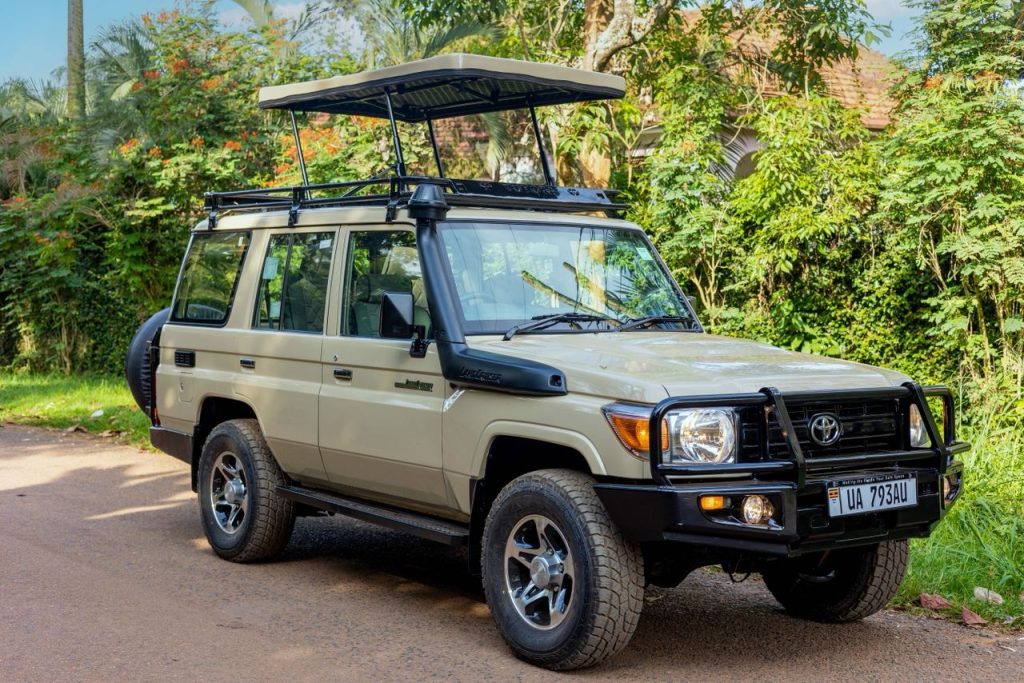
The Toyota Land Cruiser (particularly the 70-Series and 76/78 wagons) is the backbone of overland and safari travel across East Africa, prized for durability and parts availability.
The Toyota Hilux and Land Cruiser Prado are common among independent travelers and smaller tour operators for their balance of comfort and capability. The Land Rover Defender, both older and newer generations, remains popular among long-term expatriate and enthusiast overlanders. For those covering greater distances with more equipment, converted Toyota Land Cruiser troop carriers and locally built truck campers offer a self-contained base, similar in spirit to a camper van, adapted to the region’s terrain and repair infrastructure.
Essential Overlanding Gear
You do not need to buy everything before your first trip. Build up your kit as you learn what you actually use.
Shelter and sleep: A roof tent is the most common choice among East African overlanders, since it sets up quickly, keeps you off the ground away from insects and wildlife, and works on almost any vehicle with a roof rack. Ground tents remain a lower-cost alternative for shorter trips.
Kitchen and water: A two-burner gas stove, basic cookware, a cooler or 12V fridge/freezer, and at least 10 to 20 litters of drinking water per person are a sensible starting point. Water purification tablets or a filter are worth carrying as backup, since not all rural water sources are safe to drink untreated.
Recovery gear: Carry a full-size spare tire (two, if heading into very remote terrain), a high-lift jack, a tire repair kit and compressor, a basic tool set, jumper cables or a jump starter, and a tow strap. In sandy or muddy conditions, sand ladders or traction boards are strongly recommended, particularly around the salt flats and riverbeds of northern Kenya and southern Ethiopia border routes.
Navigation: Cell coverage is inconsistent outside major towns and parks. Tracks4Africa is the most widely used offline mapping app for the region, and it is worth downloading GPS tracks in advance.
A paper map as backup, along with a basic understanding of your route’s key waypoints, is good practice. A satellite communicator is a worthwhile investment for genuinely remote routes, such as northern Kenya, the Omo Valley, or western Tanzania.
Power: A dual-battery setup or a lithium battery bank will keep a fridge and lights running without draining your starting battery. Solar panels are useful for extended trips, particularly during the dry season when sun exposure is reliable.
Permits and documentation: Unlike many other overlanding regions, East Africa requires attention to park fees, conservancy fees, and, for cross-border trips, a Carnet de Passage, vehicle insurance valid across borders (such as COMESA Yellow Card), and up-to-date passports and visas. These logistics are as essential as any piece of physical gear.
Planning Your First Overlanding Trip
Step 1: Choose a manageable destination. A good first trip is two to four days, and experience. Areas such as the Maasai Mara conservancies, Lake Naivasha and Hell’s Gate, the Ngorongoro–Serengeti corridor, or Uganda’s Kidepo Valley offer accessible routes with varying degrees of remoteness for beginners and experienced overlanders alike.
Step 2: Get to know the route. Check out Tracks 4Africa or Overlander for recent trip reports, road conditions and campground spots. Consult the rainy season calendar for your location; roads that are easily traversed in the dry season might turn impassable within hours of heavy rains.
Step 3 Prepare the car. Check the tire treads and pressure. Service the automobile. Check all the fluids and make sure that the spare tire is properly inflated. For long dirt stretches, consider letting a bit of air out of your tires and bring a compressor to pump them back up before you hit the pavement again.
step 4. Pack with intention. The most common mistake beginners make is overpacking. Prioritize water, food, shelter and recovery gear and think of everything else as optional until you determine what you actually require on the road.
Step 5: Travel responsibly. East Africa’s parks and conservancies depend on responsible visitor behavior to remain viable for wildlife and local communities. Stay on established tracks, pack out all waste, respect community and conservancy fees, and follow guidance on wildlife distance and night driving restrictions, which vary by park and country.

Why the Region Rewards Independent Overland Travel
East Africa offers a rare combination for overlanders: diverse terrain within relatively short distances, from Rift Valley escarpments to alpine forest, savannah, and desert; a strong culture of vehicle-based travel already built around safari tourism; and an established network of mechanics, parts suppliers, and fuel stops built around the Toyota Land Cruiser and Hilux platforms.
The trade-off is preparation. Cross-border logistics, seasonal road conditions, and the distances between services demand more planning than overlanding in regions with denser infrastructure. For travelers willing to do that planning, though, the reward is access to landscapes and communities that a standard lodge-based safari rarely reaches.
Frequently Asked Questions
Is overlanding the same as going on safari? Not quite. A safari is typically guided, with a fixed itinerary and vehicle. Overlanding is self-directed, with the traveler responsible for the route, camp, and vehicle recovery. Many overlanding routes in East Africa pass through or near the same parks and conservancies used for safaris.
Do I need a 4×4 to overland in East Africa? For short trips on maintained roads, a capable AWD vehicle may suffice in the dry season. For most rural routes, and especially during the rainy season, genuine 4WD with low range is strongly recommended.
How much does overlanding cost in the region? This varies widely. A short trip in your own vehicle with basic camping gear may cost little beyond fuel, food, and park or conservancy fees. A fully built expedition vehicle represents a larger upfront investment but serves travelers for years. Most people start with modest gear and upgrade as they gain experience.
Is overlanding safe in East Africa?
Yes, if properly prepared. Main risks include mechanical failure in isolated places, getting bogged down on wet roads and dealing with unfamiliar border procedures.
These are manageable with the right vehicle preparation, documentation, and route research. A satellite communicator and a well-stocked recovery kit are strongly recommended for remote routes.
Where can I start overlanding near me? Almost every East African country has accessible entry points: the Maasai Mara conservancies and Lake Naivasha area in Kenya, the Ngorongoro–Serengeti corridor in Tanzania, Lake Bunyonyi and Kidepo Valley in Uganda, and Akagera National Park in Rwanda are all reasonable starting points for a first multi-day trip.